
Pacing fast and slow: how to structure a scicomm article
Applying creative writing to scicomm series we look for ways to explain what effective science communication looks like and how to improve your writing with a dive into the world of creative writing. Each article discusses a different element of writing and storytelling.
written by heini, kavya, mimmu, Saara, lotte and vinaya. illustrated by kenia, sophie, vicky and lasya. Should you have any comments, please let us know!
You will.
Read. This. Part.
Slower.
And you will read this part faster.
Even though the second part contains more words, your eyes likely moved through it more effortlessly. It may have felt like some kind of sorcery but it’s not – it’s just pacing. Pacing is the rhythm of your writing. It shapes how your reader experiences your text; where they pause, where they rush, and whether they keep reading at all. If done well, pacing pulls the reader along effortlessly. Done poorly, it slows them down in all the wrong places, or stops them completely. But fast isn’t always better. Just like music, good writing needs variation. Moments of intensity. Moments to breathe.
In this article, we’ll walk you through practical tools to control pacing in science communication. Most of these tools are intuitive, because you already use them when you speak. Writing, after all, evolved to capture spoken language. A simple trick is to read your text out loud: where do you naturally pause? Where do you stumble? These moments decide your pacing, whether intentional or not.
The Big Picture
Controlling pace with content
When writing about a topic you’re passionate about, it’s natural to want to include everything. Every detail feels important, every nuance feels worth explaining, and every interesting fact seems like it deserves a place in your article. However, what feels exciting to the writer can quickly become overwhelming for the reader.
Think of information as something you release gradually, not dump all at once. Rather than trying to say everything at once, you guide the reader step by step, allowing them to build an understanding as they go. This creates a sense of progression. And when readers feel like they are moving forward, they are much more likely to keep reading.
In a story or article, every paragraph has a purpose. Before you start writing, it helps to ask yourself a few key questions: What is this paragraph doing? Why does the reader need this information right now? How does it connect to what came before, and how does it lead into what comes next? Thinking about your article in this structured way helps prevent unnecessary digressions and keeps the pacing focused and intentional.
You can treat each paragraph like a mini-story. It should have a purpose in creating some form of movement, a clear role within the larger narrative, like giving the reader a new piece of the puzzle. It does not mean that a paragraph has only one purpose, it can do many things at once like introducing a concept while also raising a question, or providing background while hinting at a problem. Thinking about how each paragraph influences the pacing and tension helps avoid flat, purely informational blocks of text. From the reader’s perspective, too much information delivered at once doesn’t feel rich – it feels heavy. Dense paragraphs packed with multiple ideas, technical details, and examples can slow the pacing dramatically, making the article feel longer and more difficult to get through. Instead of being drawn into the story, the reader may feel like they’re wading through it.
The concept of “in late and out early” discussed in our previous article also works on a paragraph level. If a paragraph takes too long to get to its point, the reader may lose interest before the idea even arrives. If it lingers too long after the point is made, the pacing drags. Cutting unnecessary setup and trimming excess explanation keeps the momentum going.
At the same time, pacing is not just about speed, it’s also about giving the reader space to breathe. Not every paragraph needs to introduce something new or complex. Moments of clarity, recap, or simplification allow the reader to process what they’ve learnt so far. Without these moments, even well-structured content can feel overwhelming.
Interestingly, when you take the time to plan your content, you’ll often find that you need less information than you initially thought. Many complex scientific ideas can be communicated effectively with fewer details, as long as those details are carefully chosen and clearly explained. The challenge in science communication lies in finding the right balance: providing enough context for the reader to understand the topic, but not so much that they feel overwhelmed. This is why having an external editor or reader can be incredibly valuable, they can help identify what is essential and what can be removed without losing meaning.
Controlling pace with tension
Once you’ve figured out what information your article needs, you’re ready to build your story – and all good stories need tension. At its core, tension doesn’t mean constant action, it is the feeling of anticipation that keeps the reader hooked.
After hooking the reader, you need to keep building tension paragraph after paragraph and release it only just before the end. In an unputdownable murder mystery, the hook is the “whodunnit” and tension builds as you keep finding clues along the way until the culprit is finally identified. But if you find out the who, what, and why on the second page, you have no reason to keep reading. In other words, if you resolve the central question too soon, the reader has no reason to continue. The story loses momentum.
This doesn’t mean you should withhold information artificially, but rather that you should think carefully about the order in which you present it. Gradually revealing information – building from simpler ideas to more complex ones, or from problems to potential solutions – helps sustain the reader’s interest over time. It also mirrors how understanding naturally develops, making the article feel more intuitive to follow.
Tension can seem like a tricky concept but luckily, we can learn from creative writers who have already cracked the code of tension building. There are several common story structures, but at their core, most stories are composed of five sections: exposition, rising action, climax, falling action, and resolution. We think this recipe can be loosely applied to writing scicomm articles, as well.
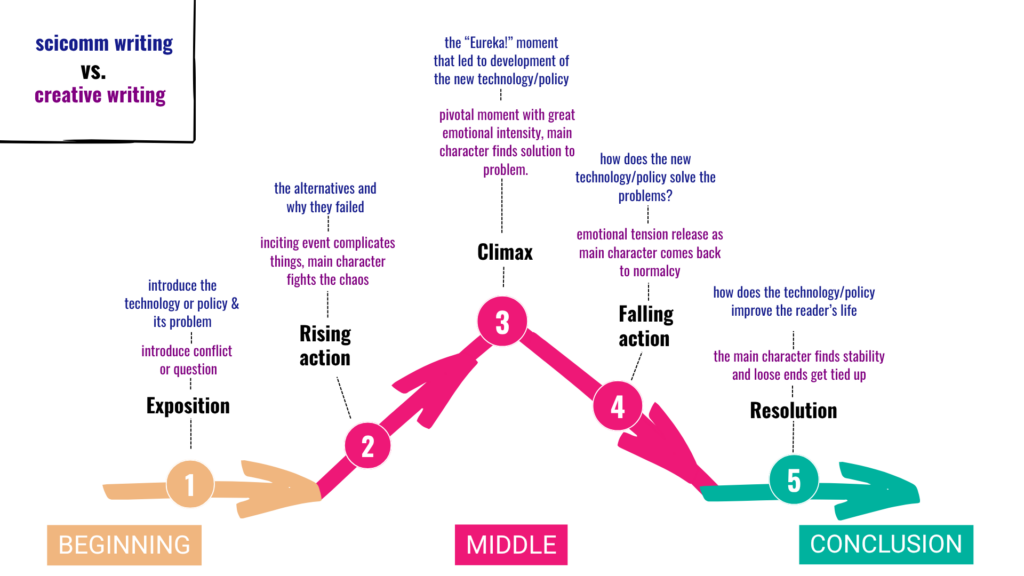
Beyond this general structure, there are also story frameworks that can help frame the science and maintain pacing. A time bomb introduces urgency by making it clear that something will happen if a problem is not solved, for example “If we don’t find a cure, more people will die.” Even a travel log structure can work. You could follow how scientists arrived at a discovery by completing different quests to create a sense of movement and direction. These frameworks work because they give the reader something to track.
Whatever structure you use, one principle remains the same: don’t reveal everything at once. Space out key insights and allow understanding to build gradually. Too many revelations in quick succession can feel overwhelming, while a well-timed reveal can be both satisfying and memorable.
The Brush strokes
How to control pace with punctuation, paragraphing, and word choice
Pacing doesn’t only happen at the level of ideas, it also lives in the details. As you saw at the very beginning of this article, the choice of punctuation and paragraphing can be extremely powerful. Punctuation acts as a set of signals that guide the reader’s rhythm. Full stops, commas, ellipses, and paragraph breaks can give your reader a natural chance to pause and take a breath. When used effectively, these pauses make the text easier to follow and more enjoyable to read. However, the balance is important. Overusing punctuation can make the text feel fragmented and slow. On the other hand, using too little punctuation can cause sentences to run together, making the text feel rushed and difficult to understand.
The relationship between sentence length and pacing is not always intuitive. Short sentences create frequent stopping points, which can actually slow the reader down and draw attention to each idea. This can be useful for emphasis or for conveying urgency, as it mimics a faster breathing pattern. Longer sentences, on the other hand, can sometimes be read more quickly because they flow without interruption—though if they become too complex, they can also slow the reader down as they try to untangle them.
If we write with no punctuation we just keep reading on and there is no chance for us to stop and digest what we have read making it really difficult to keep up with the content
When we use proper punctuation, however, our brain gets a chance to really take in the information – be it simple or complex – and it’s easier to enjoy the reading experience.
Paragraphing works in a similar way but on a larger scale. Each paragraph represents a distinct idea or step in the argument, and breaking your text into paragraphs helps create a clear structure that the reader can follow. It also gives the reader visual and cognitive breaks, which are especially important when dealing with complex or technical information. Long, unbroken blocks of text can feel intimidating and slow to read, even if the content itself is interesting.
At the same time, paragraph breaks can be used strategically to direct attention and create emphasis. A short paragraph, sometimes even a single sentence, can signal a shift in perspective, highlight an important point, or create a moment of pause. For example, Anastasiia used a paragraph break to switch gears very effectively in her article about NAD:
If you are on a budget, there are plenty of substitutes for the IV, like NAD nasal sprays and self-injection kits, which can be delivered right to your doorstep. […]These precursors are available for order in pill or powder form, ready for consumption, without any medical prescriptions. It sounds like the perfect solution!
…or does it?
Please hold on before you click the order button, as there is some fine print you should familiarize yourself with.
See how the first part makes it seem like NAD is a miracle drug but the second part clearly provides an opposing view. The question “or does it?” in between the two serves as a connector, a way to signal to the reader we’re now considering the other side of the coin. This technique can be very effective for introducing contrast or building tension, but like all pacing tools, it works best when used sparingly.
Aside from punctuation marks, technical terms, abbreviations, and numericals can slow down the pacing because the reader is forced to put in effort to understand the meaning. This is not to say you should eliminate all jargon, abbreviations, and large numbers, but consider whether these are truly necessary, or whether there’s an alternate way of conveying the same message.
Finally, mixing different types of writing – such as narration and quotes – can influence pacing as well. Alternating between explanation and reaction (for example, presenting a scientific idea and then showing how someone responds to it) can create a natural rhythm that keeps the reader engaged.
‘Differences of sex development’ (DSD) are inborn disorders that involve atypical development of anatomical, gonadal and/or chromosomal sex. [… ] Depending on the definitions used and the populations studied, estimates about individuals with DSD go from approximately 1 in 20 000 to 1 in 200 of the population. […]
As a stem cell researcher studying early ovarian development, I’ve come to learn a lot about DSD over the last three years of my Ph.D. However, most of the information I have obtained has always been from a scientific perspective: the different categories of DSD, the disease mechanisms, etc. All in hopes of increasing our understanding of DSD and, in the longer run, helping with DSD-related medical struggles such as infertility. But as I went deeper into my studies, I started to grow an interest in studying DSD from another point of view. Namely, I came to the realisation that DSD is not merely a simple biological problem but also has a lot of social and psychological implications.
See how Laura Danti introduces us to the concept of differences of sex development and then comments on the research by relating it to her own view of the topic.
Resolution: Pace your pacing
Structuring information, building tension, and controlling sentence-level rhythm are all powerful ways to shape how your reader experiences your writing. However, their effectiveness depends heavily on how they are used.
A common pitfall is overusing these techniques. Too many short paragraphs, too many rhetorical questions, or too many attempts to create emphasis can make the text feel disjointed rather than engaging. Instead of guiding the reader, the writing begins to feel erratic, with constant stops and starts that disrupt the flow. At the same time, underusing these tools can lead to the opposite problem: writing that feels dense, monotonous, and difficult to navigate. Without variation in sentence structure, paragraph length, and pacing, even well-written content can become tiring to read. Sadly, there is no simple formula for achieving the perfect balance. Pacing is something that develops through practice, revision, and careful attention to how your writing feels from the reader’s perspective. Reading your work aloud, getting feedback from others (like from TSB’s editors), and experimenting with different structures are all valuable ways to refine your writing.
A useful principle to keep in mind is that emphasis only works when it is selective. If everything in your article is highlighted, nothing stands out. Allow your reader to speed up in some places and slow down in others. Ultimately, that variation is what keeps them engaged, from the first sentence to the last.
Less is more, but too little goes nowhere.