What science is and isn’t – the perspective of a researcher
Mahalakshmi Karthikeyan is a Doctoral Researcher at the University of Turku. Her research focuses on understanding macrophages in the tumor microenvironment and she likes to think of herself as an immunologist fascinated by the hidden conversations between cancer and the immune system. When not in the lab, she enjoys painting, journaling, and discovering cozy cafés.
This article is part of the myths, mysteries, and misconceptions theme.
edited by heini and Saara. illustrated by kenia, sophie, and vicky. Should you have any comments, please let us know!
When I first stepped into the world of research, I expected to find answers, uncover truths, make discoveries, and solve problems. In reality, I spent my days troubleshooting failed experiments and learning to embrace uncertainty. I imagined my days would be filled with designing new experiments and collecting data, but much of my growth came from understanding why things didn’t work. I thought I would fully grasp the systems I studied, but I was humbled by their complexity and the unexpected results. I discovered that collaboration, discussion, and shared curiosity were at the heart of progress. Over time, I realized that science isn’t about finding answers, it’s about asking better questions.
As a PhD student, I have learned that science is one of the most misunderstood human endeavors. The misconception doesn’t just exist among the general public; sometimes it permeates even those deeply immersed in it. Popular culture often portrays scientists as lone geniuses, hard at work in laboratory montages in films like The Theory of Everything, achieving breakthroughs in sudden flashes of insight amidst a whirlwind of equations and lab equipment. While those stories are compelling, the reality is far more complex and, in many ways, far more beautiful.
Beyond the Lab Coat: What Science Really Looks Like
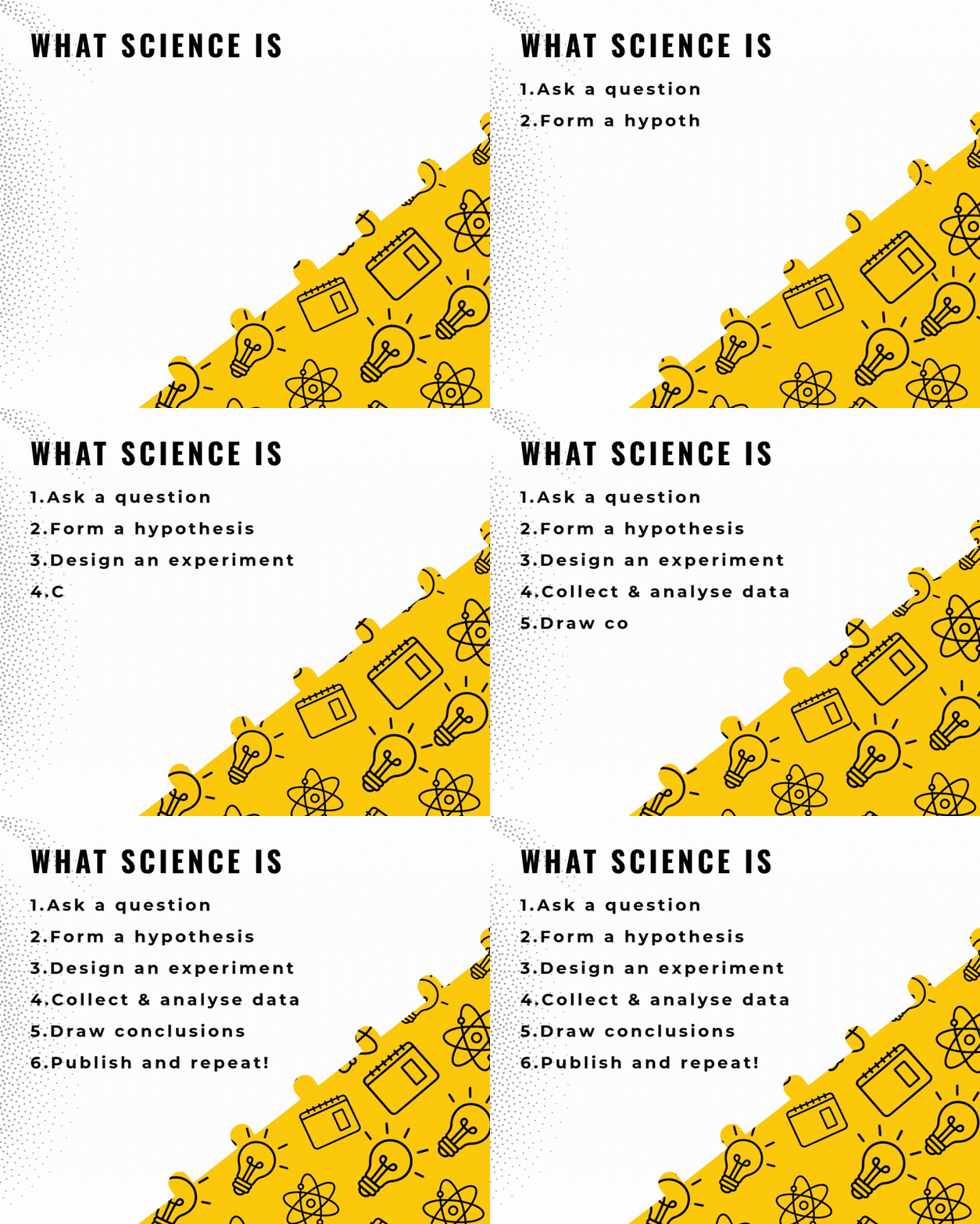
Unlike seen in movies, science is rarely about instant breakthroughs. It is a slow, deliberate process of asking questions, designing experiments, and following the data wherever it leads, even when the path is unexpected. The first questions we ask can be wrong, too vague, or based on assumptions that don’t hold up. But through failure, surprising results, and patient analysis, we gradually refine our focus, deepen our understanding, and move closer to meaningful discoveries.
Alexander Fleming’s discovery of penicillin is most often described as a stroke of luck. In reality, it was his attention to a “failed” experiment and curiosity about mold contamination that paved the way for antibiotics. Similarly, the development of the mRNA vaccine was not an overnight success. It was the result of decades of incremental progress, persistence, and repeated setbacks, particularly by researchers like Katalin Karikó, who repeatedly asked how synthetic RNA could be stabilized and made non-inflammatory. During the COVID-19 pandemic, guidance and procedures evolved as researchers’ understanding of the virus improved. This was not a sign of cluelessness, but of science learning and adapting in real time.
This example addresses another common myth: that changing theories indicates that science is unreliable. On the contrary, change is a sign that science is working. New data lead to improved models and updated recommendations. Vaccine guidance evolved during the pandemic as variants emerged, not because science failed, but because it responded to new evidence.
From a lone wolf to a team player
Science is far from a solitary pursuit, where breakthroughs come from lone geniuses working in isolation. As a new researcher embarking on a PhD, I quickly learned that biology isn’t just about petri dishes, pipettes, programming and mathematics. Although these technical and quantitative skills are important, the ability to work together with people is perhaps even more crucial. From coordinating with collaborators to mentoring students or communicating your work to a broader audience, human connection is central to scientific progress.
It is a misconception that a single study – or scientist – can prove a fact. In reality, scientific knowledge emerges from repeated experiments, long-term observations, and the careful accumulation of evidence. People also often claim that science is unbiased. While the scientific method strives for objectivity, scientists themselves are human, prone to error and bias. That is why systems such as peer review, replication, and transparency are essential. They challenge assumptions, correct mistakes, and strengthen the reliability of conclusions. In this way, teamwork is essential in producing good and reliable science.
It is not the steady beat of a lone genius, but the collaborative, curious, and resilient spirit that drives discovery forward.
And here is the key truth: good science is not about immediate answers. It is about adaptability, resilience, and following where the evidence leads. The blending of disciplines, uncertainties, and personalities makes up the real heart of science. It is not the steady beat of a lone genius, but the collaborative, curious, and resilient spirit that drives discovery forward. Only after navigating many wrong turns – as individuals and as a scientific community – do we even recognize the right questions to ask. Science is messy, uncertain, and deeply human. It is in this process, rather than in a single eureka moment, that the true power of discovery lies. It may not be glamorous, but it is one of the most powerful tools humanity has ever built.
Science is a method, not a belief system
It always gives me pause when someone asks: “Do you believe in science?“ To me, this question reflects a deep misunderstanding. Science is not something that one believes in; it is not an ideology or philosophy. It is a method of inquiry grounded in asking testable questions, making observations, gathering evidence, conducting experiments, and continuously refining understanding based on the data. It is not always certain, but it always gives the best available explanation, which paves the way for new discoveries.
People often assume that scientists know what they are actually doing, but the truth is, research begins with uncertainty. “I don’t know” is the starting point. Scientists explore the unknown through trial and error and refining their questions and methods as they go. That is why the scientific process is set in place. Science is, in fact, a rigorous process that is meant to ensure we have really thought of everything. Misunderstanding how science works leads to serious consequences. The anti-vaccine movement is a current example of such. Such movements often arise from the expectation that science should always provide perfect, risk-free answers. When it doesn’t, myths and conspiracies always find a way. Findings evolve, as they did with COVID-19 boosters and changing virus variants. This does not mean science is unreliable, but responsive and adapting to newer evidence. It is often taken as a weakness, but it is actually a strength.
What I have learned as a Researcher
My research days don’t feel like movie montages. They feel like trial and error, troubleshooting code, and staring at confusing data. I have learned that failure is not a bug in the system. Science moves forward, not in leaps of genius, but in slow, methodical steps, often built on collaboration and critique. What keeps me going is curiosity and the knowledge that even small pieces of progress add to something much bigger than myself.
In an age of misinformation, conspiracy theories and scientific skepticism, understanding what science is and isn’t is more important than ever. We need to move beyond treating science as a finished product and instead open up the process behind it. That means communicating clearly, admitting uncertainty, and being willing to say: “We’re still figuring it out.” By doing so, we not only increase public understanding of the process but also build trust by showing that science is not about having all the answers but about never giving up on the search for them.
Science is the only job where being wrong is a part of the plan – your experiments fail, code crashes, cells die – yet you call it a PRODUCTIVE DAY.