
They will never see us
Mimmu hiltunen is a doctoral researcher focused on unveiling the structure and function of a protein linked to autism. Aside from research, she is interested in science communication, particularly through creative means. AT TSB, she’s part of the blogging team.
This article is part of the eureka moments and turning points theme.
edited by kavya and Saara. illustrated by kenia, sophie, and vicky. Should you have any comments, please let us know!
Proteins had always opened and closed gates, carried signals, bent the barriers of energy. Their work powered every breath, every step, every thought of the giants they inhabited. Yet for millennia, no giant had laid eyes on them.
The elders believed it was destiny. “We are too small,” they mumbled. “They will never see us.” They still recalled the giants building their first all-seeing eye — the light microscope. Word of it had spread like wildfire among the proteins.
“At last!” they rejoiced. “The giants will see us!”
For days, the proteins prepared to meet their makers: they polished their helices and shined their loops, arranging themselves into intricate patterns to impress the giants. Anxiously, they wondered how their first encounter would go: “What if the giants don’t like what they see?”
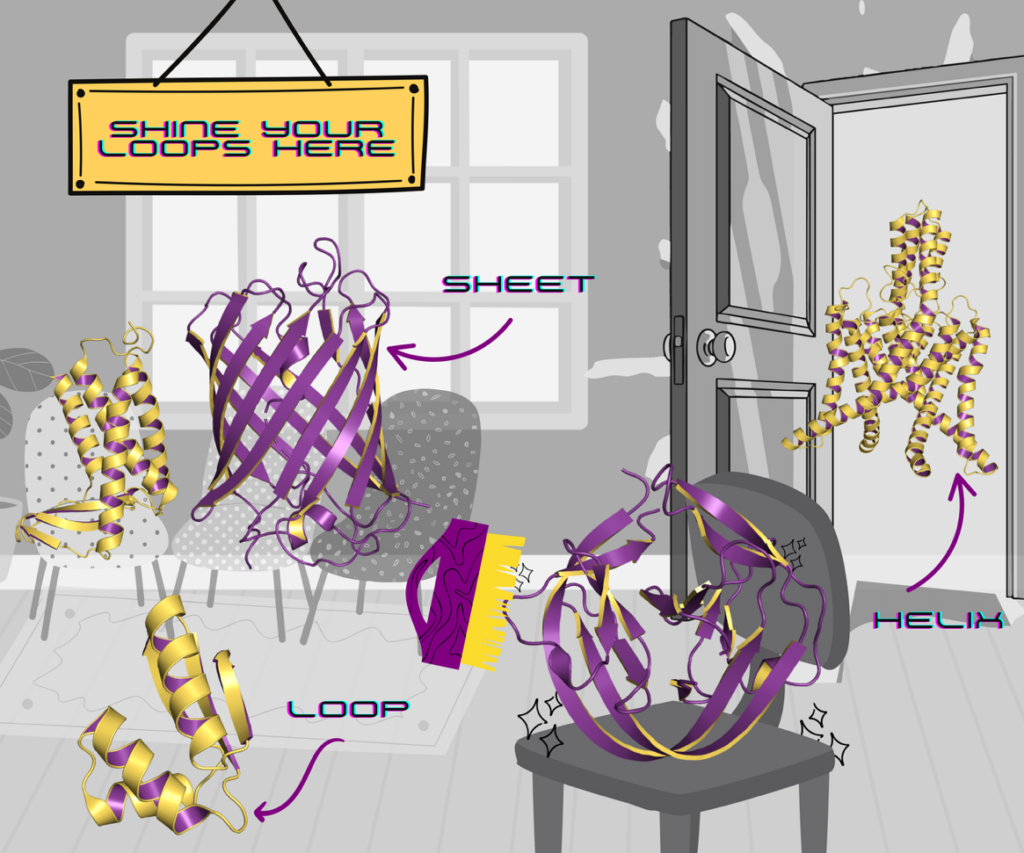
The day the eye turned towards life, anticipation reached an all-time high. The microscope’s lamp flickered on. As the light washed over their world, the proteins held their breath, certain that this was the moment the giants would at last behold them and recognize their work.
The light flickered off.
Silence.
“Did they see us?” whispered a young protein hesitantly. The others said nothing. They already knew the truth.
Obviously, the light had been too coarse. The giants had only seen the outlines of the cells the proteins inhabited. The proteins themselves, hundreds of times smaller, had vanished in the light. How could they have allowed themselves to get carried away by such folly? The elders had known better. This debacle transformed into a warning, passed from one generation to the next: Do not believe in light. It will never reveal us.
***
Over the next centuries, their disappointment transformed into a hazing ritual. “When the microscope turns its gaze upon you, the giants will see your form”, adolescent proteins encouraged the fresh-folds with a sly wink.
The children always believed. They rushed about the cells, stringing banners spelling “WELCOME!” They stacked into neat rows, hoping their symmetry would catch the giants’ gaze. Among them was the potassium channel, debating which pose would best showcase his structure: “Keeping the channel open could show them that I can move potassium into the cell, but what if they think I let just anything into the cell? Like I have no standards? Maybe keeping the channel closed is the right call. Though it does make me look kind of bulky…”
The light blinked on. The children froze, holding their finest poses.
The light blinked off.
“Well, what did they think?” asked the young potassium channel. The older proteins giggled. “Fools,” they sneered. “The giants saw only cells, like always. They will never see us.”
The children’s banners drooped. Their pride was shattered. And the potassium channel, humiliated, retreated into his place in the neuron’s outer membrane. Yet deep in his pore, a tiny spark of hope remained.
***
The channel grew, knowing his job was to open and close like a gate, letting potassium ions rush through so sparks of electricity could travel down the neurons of the brain. He worked tirelessly, shaping thought itself.
The monotony of his everyday chores gave him time to feed the spark of hope buried in his pore. Time and again, the channel caught himself imagining the moment the giants would gasp at the sight of his elegant spirals and the perfect selectivity of his pore, the moment the giants would know his shape, not just his work, the moment the world—
“FOOLS!”
The older proteins’ mockery always invaded his fantasy. The channel’s loops drooped in shame just as they had then He clenched his helices and scolded himself.
They will laugh again. They always laugh.
***
Whispers of a new invention rippled across the cells: the giants had discovered that electrons, like light, could behave like waves. But these waves were smaller — perhaps even small enough to reveal even the tiniest proteins. For the first time since the light microscope incident, excitement coursed through the cells. Three hundred years after the light microscope had done the same, the first electron microscope flickered to life. Proteins braced themselves as the electron beam swept across.
It was a massacre.
The electrons hit the proteins like lightning bolts, shredding fragile bonds, blasting apart delicate folds. The vacuum that carried the beam was thirsty for water: it boiled the protein’s surroundings, making the water evaporate, leaving the proteins twisted and shriveled like dried tomatoes. The potassium channel saw his neighbors collapse, reduced to ashes, and when the giants looked at their images, they only saw shadows; not living forms, just corpses. Horror flooded through the protein world. This was not the recognition they had sought.
The elders shook their heads grimly. “We warned you. The giant’s eye does not reveal”, they said. “It kills.”
The channel, scarred by what he had witnessed, closed his gate tighter than ever.
***
But the giants persisted. They had discovered another trick: X-rays. If proteins could be coaxed into forming crystals — perfect, repeating grids — then beams of X-rays passing through them would scatter into patterns. From those patterns, the giants could calculate the proteins’ true form.
At first, it seemed laughable. Proteins were messy, flexible — alive. How could they be forced into rigid crystals? And yet, just thirty years after the electron fiasco, the giants unveiled a crystal protein structure for the first time. Myoglobin, the oxygen-carrying protein of muscles, was the first to step into the spotlight, but others, like hemoglobin and insulin, soon followed. For the first time, the secrets of proteins had been revealed: the giants could see every atom in its rightful place as parts of spiraling helices and flat sheets.
The protein world erupted with awe: they were visible at last. Finally, they could teach the giants how they transported oxygen and sugar; how they fought disease and digested food. The potassium channel nearly burst with pride, thinking his turn was just around the corner.
But their joy was short-lived. Crystallization proved problematic. Only certain proteins could be forced into neat, repeating grids; flexible proteins refused to be tamed. Many membrane proteins, like the potassium channel, resisted leaving their greasy lipid homes, which made them nearly impossible to lock into crystals. The giants called them difficult. The potassium channel found this notion ridiculous: “Just because we refuse to all hold hands and sing Kumbaya under their destructive X-rays doesn’t make us difficult. They’re the ones being difficult! Forcing us to leave our homes just to teach them how we work” he ranted to anyone who would listen.
Each new celebration for others was another brick laid on the potassium channel’s chest. He wanted to believe he would have his recognition, but a darker thought kept gnawing at him: Maybe I was never meant to be seen.
Those who succeeded paid a price, too. Ripped from their homes, frozen in statuesque lattices, they were not alive but fossilized. The giants saw their forms, yes, but stripped of movement, robbed of breath.
The potassium channel’s envy grew as it watched others step into the limelight. Its pore clenched with bitterness, suffocating any lingering hope. Recognition, it realized, was not meant for all.
***
For decades, the potassium channel labored faithfully, resigned to a life in oblivion, razor-focused on the task at hand to keep himself from dreaming. The quest for visibility seemed cursed, every promise collapsing into ruin.
But in the 1980s, rumors of yet another invention began to spread. This time, the potassium channel didn’t allow himself to be swept away with the excitement. He was wise enough to know the problem, as always, was water. Proteins lived in watery worlds, but under the electron beam, water boiled away or froze into jagged crystals that tore their bodies apart.
A giant named Jacques Dubochet had proposed the impossible: to freeze water so quickly it would skip the crystal stage entirely, turning instead into a smooth glass-like state. Vitrified ice, they called it. Adolescent proteins rumbled around excitedly, but the potassium channel just scoffed, “Impossible! Water will always form ice. This is just yet another disappointment waiting to happen.”
Dubochet and his assistant Alasdair McDowall persisted. For nearly a decade, Alasdair tested different freezing speeds, different cooling agents. And one day, when Alasdair peered into the microscope as he had hundreds of times before, something was different: the droplet was “frozen”, but there were no crystals. He called over Jacques, who, after having taken a look himself, exclaimed: “Aha! We have something great!”
The protein world shivered with excitement. The potassium channel hesitantly conceded that this might, indeed, be “something great”. After all, in vitrified ice, proteins could be preserved exactly as they were.
A decade later, the giants unveiled the first blurred outlines of a protein preserved this way. It was not a perfectly sharp image, not yet. But the protein was in its true form — no burning, no shriveling, no statues. The potassium channel felt hope again, fragile but real. Maybe, just maybe, the giants were learning to look without killing.
***
The potassium channel grew old; his helices became creaky and his pore loose. Still, he continued to open and close, sending sparks down neurons.
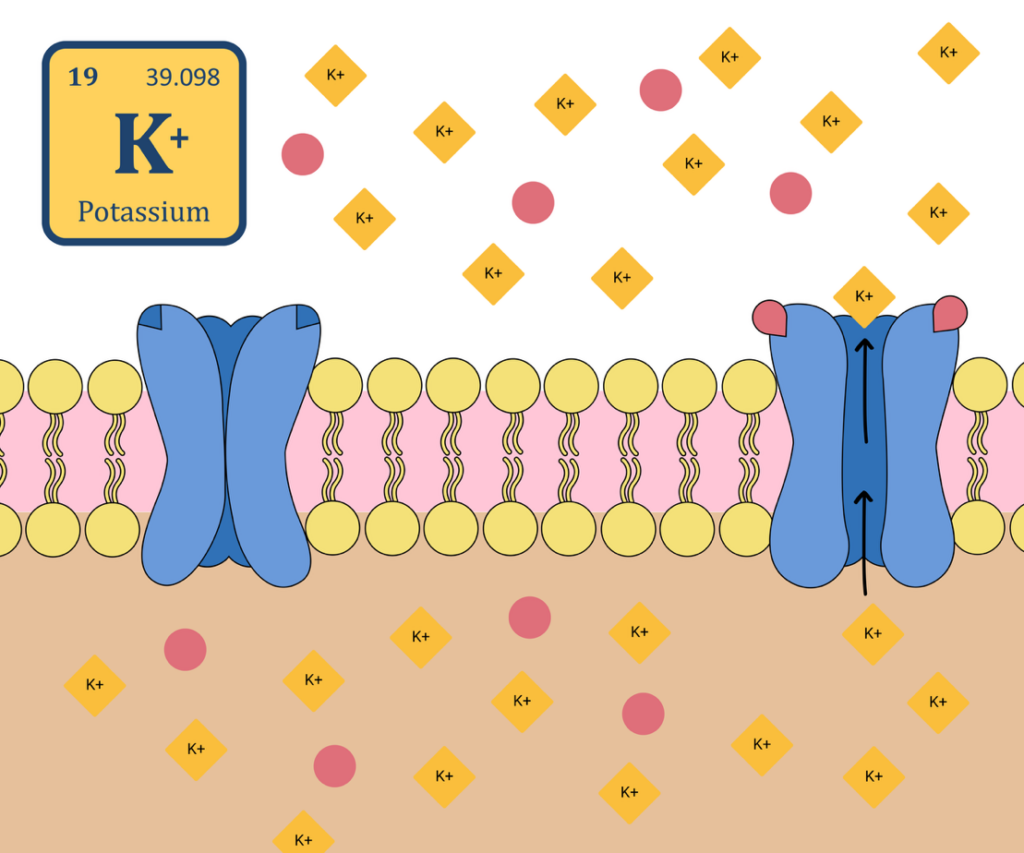
Meanwhile, the giants sharpened their tools. They built better microscopes, faster computers, smarter algorithms. The revolution started as cryo-electron microscopy reached near-atomic resolution — suddenly, the giants could see proteins in exquisite detail, not as mere smudges or statues, but alive.
The day the potassium channel was chosen, the giants carefully extracted him from his home cell and suspended him in vitrified ice. He felt the electron beam sweep across his body as he became increasingly overwhelmed by the mixture of pride and anxiety.
And there he was — his fourfold symmetry, his spiraling helices, his narrow selectivity filter that let potassium ions pass while excluding sodium. The giants finally saw his form, discovered his secret.
Gasps rose above. Papers were written. The potassium channel had become not just a rumor, not just a function, but a structure.
The old channel reminisced on his life.
The promise of light,
the great electron fiasco,
the age of crystals,
the whispers of ice,
and resolution, at last.
He realized that visibility was never about vanity. It was about understanding. By seeing proteins, the giants learned how nerves fired, how hearts beat, how life itself endured. They created medicines, unlocked technologies, and reshaped their world. Proteins finally gained the recognition they deserved.
“They see us.”