
Journey of a Researcher – From Academia to Industry, and Back to Academia
Lotte van der Jeugt is a doctoral researcher at the Department of Environmental Sciences. Her research focuses on how digital tools, such as urban digital twins, can be used for the planning, monitoring and evaluation of climate adaptation measures at a local level. She is interested in science communication to a wider audience and in her free time, she enjoys hiking, visiting museums, meeting with friends, and reading.
This article is part of the myths, mysteries, and misconceptions theme.
edited by heini. illustrated by kenia, sophie, Lasya and vicky. Should you have any comments, please let us know!
Are you curious to know more about the journey and experiences of someone who worked both inside and outside of academia? Then this is the right place for you!
For this article, we interviewed Emma, who is currently a university lecturer at the University of Helsinki, Faculty of Biological and Environmental Sciences. While experiences will differ from industry to industry, university to university, and thus from person to person, this article tells her story of moving between academia and the private sector.
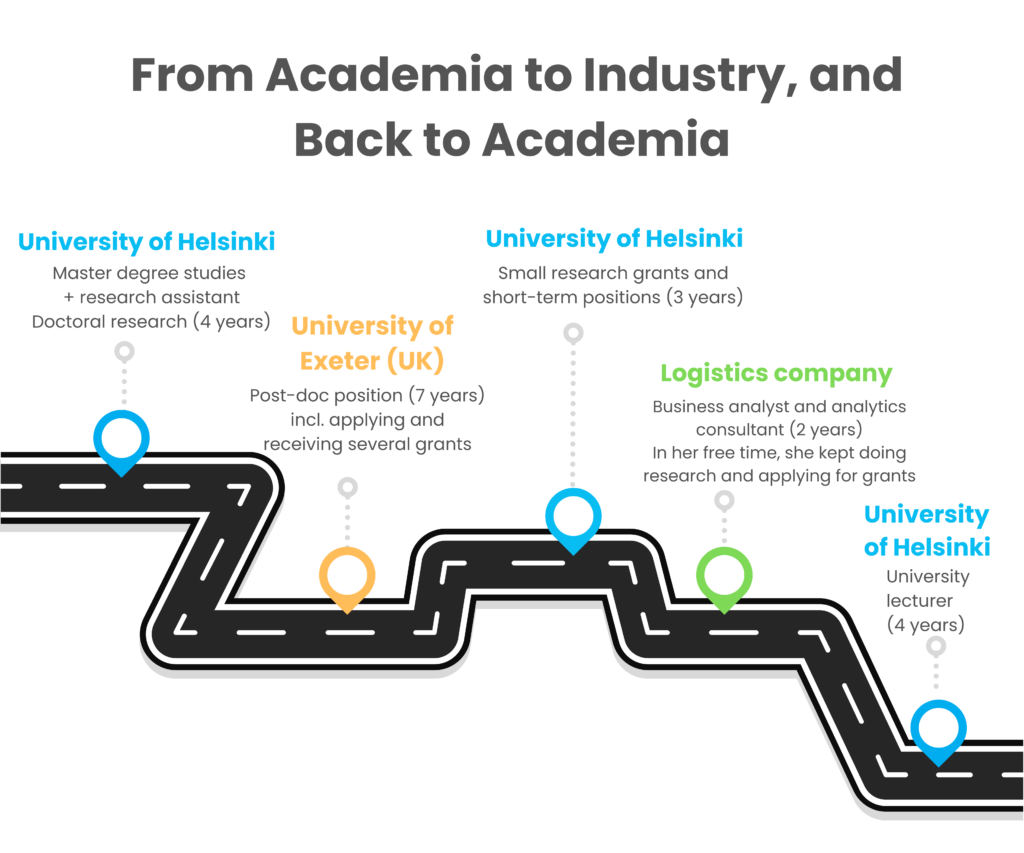
Before diving into the similarities and differences between academia and the private sector, and Emma’s experiences, you can see her career path in the graphic below.
Motivations to go from academia to industry
Emma completed her master’s and doctoral degrees at the University of Helsinki. She then accepted a post-doctorate position at the University of Exeter, but after several years, a combination of circumstances made her move back to Finland. Once back in Finland, Emma had small research grants and some short-term positions at the University of Helsinki. When these contracts were over, she dedicated about a year to writing and submitting grant applications. Unfortunately, the situation was too financially uncertain, and she needed more financial stability to take care of her family.
Emma set herself a personal deadline. If she didn’t receive any funding or long-term contract before a certain day, she would enrol in a programme to retrain as a data analyst and apply for jobs outside of academia. However, before reaching this deadline, she saw on LinkedIn that one of her colleagues from the University of Exeter had moved to Helsinki and was working at a private company. She decided to reach out to him and grab a coffee to talk about his experiences. During this conversation, he started recruiting her, and in the end, after several job interview rounds, she ended up working at the same company.
Study field versus working field – transferable skills
Emma’s background is in ecology and evolutionary biology, so it may be a surprise that she ended up working in a logistics company.
When looking for jobs closely related to ecology and evolutionary biology, Emma’s options were limited to other universities, two governmental organisations – the Environmental Research Centre, and Natural Resources Research Centre – and maybe environmental consultancies. However, while logistics doesn’t have anything to do with ecology directly, there are elements of the data analysis and some concepts that are highly transferable. For example, there is no way to completely optimise all parts of an ecological complex system at the same time; there are always trade-offs. This is something that is prevalent in logistics chains as well. From her experiences in ecology and evolutionary biology, Emma understood better how these complex systems work. Additionally, her PhD and postdoc positions have trained her on how to manage data that is not perfect, giving her an advantage over her more junior engineering colleagues.
In her new job, she had to learn new skills fast, particularly how to use software developed and managed by the company. As an academically minded person who likes challenges and learning new things, this was not an issue. She could use the skills learned during her PhD; you learn to teach yourself what you need.
Analytical skills, which Emma developed through working as an academic, include pulling knowledge together from different sources, analysing large datasets, and evaluating them to produce academic papers. These skills can be transferred to analytical roles in the industry, where your work might involve disseminating information from existing texts, making sense of large datasets, identifying patterns, and writing reports.
Furthermore, in academia, she learned to communicate research findings to different audiences, such as students and other researchers. This skill can be used in the industry to communicate effectively across different levels of an organisation or company, and with customers and collaborators. Related to this, she can present and discuss her work in front of big audiences, a skill developed in academia through presentations.
But how do you communicate academic skills to the industry in your CV?
First, Emma’s CV does not have any biological or ecological keywords or academic jargon. When covering her experience from the University of Exeter or Helsinki, she did not include any specifics on the biological substance of the roles. Additionally, she decided to leave out that she has the qualification for docent at the university, because it sounds very academic; “by bringing this up too much, they might think that I’m too theoretical for the job, so I try to keep it as practical as possible.”
Emma took a step back and formulated her skills differently than how they had been described in academia. Instead of including her teaching and conference experiences, Emma highlighted her strong communication skills. An important part of academic work is rephrasing things in a way that appeals to the audience and picking up the details that they find relevant. Therefore, Emma highlighted that she can interactively communicate her work to diverse audiences. On other skills, for example, she included that she has analysed datasets with over a million rows, and that she is able to produce publications/reports and can work to strict deadlines. Communicating her skills in this way on her CV and during job interviews helped Emma to get the job.
Differences between academia and industry
In addition to skills that you can use both in academia and in industry, Emma also experienced some differences between the two sectors. However, these differences are mainly related to working organisation and culture, and work-life balance, instead of the skills needed for the jobs.
For example, while Emma was working at the logistics company, she had her first holiday ever – and was completely off e-mail as well! Additionally, when you are sick, “you can actually just not work, and that is completely new to me because that’s (almost) never the case in academia,” Emma says. This was such a great experience for her that she will try to continue doing this, even though she is currently working in academia again. However, Emma thinks this could be challenging for her. She really likes her work in academia, which is enough motivation for her to work even when she is sick.
Another difference was the team spirit within the company where Emma worked: “The whole company was one big team, and we all worked towards the same goals, and I was not in direct competition with any of my colleagues.” This, together with an annual bonus based on the amount of value produced, led to a very nice atmosphere where people collaborated to finalise a project rather early than late. Of course, regardless of whether you work in academia or industry, the people that you work with have a big influence on the working environment. However, “the academic structures and the competition inherent in it do not necessarily support working together and working cooperatively in the same way as structures in the companies.”
In the industry, the end product will seldom have your name on it. In academia, you always have ownership – and responsibility – over your work. This can sometimes become a burden, as everything is your problem, and it is your loss if a project doesn’t fly. At the logistics company, Emma could not really decide on her projects. Her manager assigned her projects and supported her during her work and when setting personal career development goals. In Emma’s position, it was sometimes a relief for her that the management set the priorities, but also sometimes a frustration. Something Emma loves about academia is that she can decide herself what’s important, which projects she wants to do, and that she can follow her intellectual interests. This freedom is something that keeps her going forward in academia.
Skills learned from industry
After two years in the industry, Emma accepted a job offer as a university lecturer at the University of Helsinki. From her experience at the logistics company, she has learned some valuable lessons and skills that she tries to take with her in academia. The main one is a better understanding of where the diminishing returns curve starts to bend, and not to endlessly keep tweaking things.
“The whole company was one big team, and we all worked towards the same goals.”
In academia, nothing can ever be good enough. For example, you can always make an application just a little bit better. You never know where the optimum is before the diminishing returns happen, because you never get any feedback to figure this out, and the goalposts move constantly. In the industry, you usually have someone else telling you when it is good enough, when there is no point in tweaking it any further, and you can move on to the next thing. At the company where Emma was working, they sometimes dropped projects because it would take too much energy and time relative to the benefits. This is an important lesson Emma is trying to take with her when working on projects and papers. She says: “Sometimes, the best thing to do is just to wrap it up and publish. It’s not perfect, it doesn’t need to be, the best thing is to write it up and then move on to the next thing.”
Another aspect that she takes with her is the work-life balance, and to treat her job in academia more as a job. For example, trying not to work when she is on sick leave, and having an email-free period during her holiday. “It [working in academia] is a calling as well, and I love what I do, but there has to be a limit.”
Future career path
At the moment, Emma tries not to think too much about her future career path, because she realised that “you can only influence this so much. You just got to be in the right place at the right time, and if you’re not, then there’s nearly nothing that you can do about that.” Emma would love to continue in academia and hopes to get a permanent position at some point. She is thus trying to do the best possible job in her current position and making sure she stays competitive academically. If this does not work out, jobs at the Finnish research centres are an option for her.
Additionally, she knows that it would be possible to go back to the company where she used to work, which gives her “a sense of internal security.” Nevertheless, you never have complete job security. Academic employment is notoriously precarious since it depends on funding. Positions in the industry are dependent on how the company is financially doing, and jobs at the research centres are often dependent on external funding as well as governmental policies and politics. Regardless of your sector, you never know whether there will be layoffs coming at any point. Luckily, in her current position, once you have received research funding for a certain period, at least you do not need to worry about funding for the period in question, giving some security and stability.
Tips and lessons learned
If you are looking for jobs outside of academia, here are some tips from Emma based on her experiences.
Look broadly and keep many options open
Don’t exclude too many sectors and fields; there are surprisingly many choices. Instead, think about aspects that you are not willing to compromise on. For example, perhaps the company you work for must be sustainable, and “outside of that, just have a very open mind and don’t rule out anything by default.”
Networking
Talk to people in different jobs and different roles; “people are actually very willing to share their experiences and give you tips.” You can, for example, use LinkedIn to reach out to people whose profile looks interesting and relevant to you.
Knowing your skills
Try not to have too many restrictions in terms of what you can and cannot do. “We tend to think about our expertise as quite narrow because academic fields are so narrow, but that doesn’t necessarily play any role. It’s much more important that you have the meta skills”, which have been discussed earlier in this article.
Funding timelines
If you plan to stay in academia and you want to work in a certain country, one tip from Emma is to find out beforehand when the funding calls and their deadlines are to make sure you can align your plans according to these deadlines.
To conclude, Emma has one more piece of advice, both for her younger self and you: “Go towards things that excite you, because that is the most important thing. The career path is never, or almost never, straightforward, or at least you can’t expect it to be. If you work with things that interest you, with people who are fun and interesting, then you will enjoy your life, and that’s kind of what matters in the end.”